
WHY APPRECIATING ART IS SO IMPORTANT: Why Does it Matter?
By Alex Chaban
Appreciating art is important because it can discuss an idea, an expression or even an imagination. Art can help to identify, define, and discuss images with certain principles. Such images and designs are used in way to inspire the viewer through visual communication. When an artist creates art, he or she can work with either traditional or modern mediums. Such mediums can include paintings, pictures, materials, blocks or even visual strategies. An artist must follow the basic principles of design and learn different types of representation of art. Remember, art always matters when it is appreciated by its viewer.

Some people not think that art is important. They would not appreciate it or recognize the efforts needed to create awe-inspiring pieces of artwork. Art can be intriguing and inspiring. Yet, some people do not appreciate it. They have lost their sense of creativity or fascination with colors. When you think of art, you envision the famous works of artists like Leonardo da Vinci, Michelangelo, and Raphael. You would also think of Pablo Picasso, Van Gogh, Warhol, or Claude Monet.
Art has been around for generations and decades. Their form and representation have changed from time to time, but their importance, appreciation, and creativity are still admired. Did you know that art was even before when men discovered fire? We have forgotten that art has been around since the early days of the cavemen. No doubt that art has played a very significant role throughout our history. It has shaped our culture, our traditions, and our way of life. Art is also a part of our daily lives. Everything that we do, wear, or achieve is inspired by art in some way. Art revolves around us in many ways. We can take inspiration from art from nature, colors in the sky, landscapes, flowers, animals, people, and our culture. The clothing we wear, the movies we see, or the video games we play are all inspired by art. The cars we drive are influenced by art. The pictures of ourselves are influenced by art. The pictures in books or magazines we read are influenced by art. It's important to appreciate this art around us. Appreciating art and artists is important because art continues to be a part of our lives and our future. It is also related to the future of many generations to come.
Art in the Early Days
Men in early civilizations appreciated art. They used it to communicate with one another and even with the world. We know that early men didn’t use art as a formal written language. Still, they did use drawings to depict their everyday lives. These drawings conveyed important information, emotions, and hopes. We can still look at those artistic images and appreciate them in a way. It gave us a clear understanding of their daily struggles and successes. It also provided a chance to connect and empathize with learning about their culture.
Appreciating and Admiring Art
Art is not meant to be overlooked. People need to appreciate it. They should admire it. They should be inspired by it. Art can teach us many things that we can’t even imagine. Art should be observed for its true essence. It reveals who we are and what we can aspire to become in the eyes of the beholder. Art can stimulate thought and reason. That is why it is known to have brought a revolution in many cultures. It can stimulate ideas. It allows viewers to draw their own emotions in their thoughts. Viewers can pull from their personal experiences when they meet them. Art can be influential in a way as it naturally develops critical and innovative thinking skills. That is why children in their early ages are inspired to draw and paint. Art also teaches us many important qualities such a listening, observing, and responding to multiple perspectives. That is why art should be admired and appreciated by people from all different walks of life. There is much more to learn about art and artists by reading the real-life account of an inspiring artist.
The Importance of Art
Art matters in terms of visual effects. For example, let us study the Picasso Guernica’s painting, which was completed in 1937. Any viewer at the first glance will know how incredible, challenging and complex work it appears to be. It would easily convey a composition and understanding of art itself. If anyone needs to make an interpretation of art, he needs to understand that art in a way can easily:
- Inspire or motivate the viewer
- It can identify and describe the difference between the form and content used in the art
- It can identify the five elements of design
- It can identify and distinguish how design principles can connect visually
- It can differentiate between different representations of art such as realistic, abstract or non-representative art forms
Art is the best way to visualize or analyze any content. It can define different elements and principles of a subject. When we look at any piece of art in an exhibition, museum, or forum; we can certainly decipher its expression, idea, or even learn through a lifetime or culture of the era that the piece was created. Therefore, art is formed through a lifetime of knowing about a culture or the times in which people have lived. You can easily select the piece of art which inspires you most and even take mental notes while analyzing its conceptualization.
Art and its Elements of Design
Art is a combination of various elements such as color, shape, texture, line, shade, mass and space. Certain design principles are kept in mind to combine or intermix such elements while creating a piece of art and making it unique and captivating. The artwork and its content are made by linking the elements together to make a deeper meaning.

Art and its Meaning
Art may be described as a process that allows us to reflect and consider the meaning of different things and concepts around us. It can be a representation of ideas, imagination, expression or even culture. The deeper your analysis is, the better you can connect with the experience and knowledge of the artist. You can even take inspiration from Carole Feuerman and her book, ‘My Hyperrealist Life and Legacy’. In her book, she describes her life experiences, how she fell in love with art and what inspired her to become an artist. This book is a must-read for all those who are inspired or motivate to become an artist, those who have a deeper connection with art and its elements.
How to Learn to Discover Yourself
By Alex Chaban
Imagine waking up one morning and then realizing that you are sitting in your car while being all dressed up, showered, and drinking a hot cup of coffee. You may have no recollection of your conscious memory, about how any of this may have happened with you. We have evolved so many in the present era that we run into our day's complex routine procedures. It’s like that our mind is on autopilot mode, and our unconscious processes are so much faster, reliable, and more subtle than our conscious efforts, to comprehend and understand the world around us. As things revolve around us, we need to know much about ourselves to get through life as we know it.

Life is not a Ride but a Journey
Life is not a ride where you can just jump on the driver’s seat and start your journey, deciding on where to go and where you need to be. It is a journey of unexpected turns and twists. You may never know where you might end up. Learning to discover yourself is essential because you would know who you want to be and what efforts you need to achieve by exploring yourself.

Importance of Discovering and Exploring Yourself
When you truly learn to discover and explore yourself, you know about your passion, what you want to achieve in your life, what career choices to make, what you are good at, and what skills you have to accomplish your goals. It can also help you understand the people you are comfortable with to spend your time. You can tell them about the things which you prefer talking about and give information about yourself. Knowing yourself can help you drive your motivation levels about new things in life and be comfortable. You can incorporate new information or let it go.

You cannot change without knowing yourself, and you cannot live in a world of change without changing yourself for the better.
Taking on Life’s Challenges by Discovering Yourself
Life will throw all kinds of troubles and difficulties at you, but you need to maintain your resolve and focus. To know yourself can gain you better benefits in life. It can lead to the results which you want as you can make the choices which suit you best. You just need to make a bit of effort to know yourself better. You cannot guarantee that you are smart, strong, or good, no matter how much you peel off your personality layers. One thing is for sure. The more you know about yourself, the more you can explore the things you are good at, the more opportunities you can gain in life and make the best of them. Try to learn different parts of your personality and explore what you like to do that works out well. Therefore, you don’t have to know the stuff and put it on autopilot in your unconscious.
Try to learn more about yourself by reading the book ‘For my Legacy’ by Carole Feuerman. She knew from a young age about her strengths to be an artist. Her Grandfather helped her realize and identify her passion, and by learning herself and her skills as an artist, she became a well-known artist and got to be where she is today. In her book, she motivates people on how they can know about themselves, just as she did, and by utilizing her passion and skills, her artworks are famous and owned by 18 museums.
Conrad New York Midtown Debuts Hyperrealist Sculpture 'Leda and the Swan' by Artist Carole Feuerman

This Permanent Installation Serves as the Cornerstone of Conrad New York Midtown's Avant-Garde Art Program
NEW YORK, August 16, 2019
Conrad New York Midtown unveiled "Lida & The Swan" by hyperrealist t artist Carole A. Feuerman. This permanent sculpture installation in the lobby serves as the hallmark of the hotel’s extensive, curated art program and a nod to Conrad Hotels & Resorts’ commitment to the arts. Influenced by the Greek myth of the same name, this
contemporary sculpture revives the story by bringing in modern themes of feminism and strength. Upon entering the lobby, guests’ eyes are immediately drawn to the larger-than-life sculpture depicting a female figure in an ornate bathing costume and crystal-clad swim cap lounging on a bright white inflatable swan. The life-like sculpture appears to float on the plinth, layering in a Zen mood to the calm and serene lobby space. Feuerman’s interpretation of the classic tale – where Zeus, disguised as a swan, overpowers and seduces Leda who then bore Helen of Troy – showcases Leda, the bather, in a position of feminine dominance over Zeus, the swan. “Conrad New York Midtown’s art collection inspires guests to appreciate the array of art that New York City offers,” said Robert H. Rechtermann, general manager. “Given our location in Midtown, we’re steps away from the Museum of Art and Design, as well as the soon-to-be reopened Museum of Modern Art, and have a bevy of very talented artists at our fingertips. Carole’s sculpture is the perfect commissioned piece of art to entrance guests and introduces them to our art program.” Feuerman, a born-and-bred New Yorker, is the sole female founding member of the 1970s’ hyperrealist movement, and her art has garnered worldwide acclaim. Leda and the Swan is made with Lacquer, 24k gold leaf, and Swarovski Crystals, which allow the light to refract and sparkle, much like it would if placed on the surface of a body of water. The sculpture is meticulously rendered with hundreds of layers of paint to portray the nuances of life-like skin tones. It was commissioned and purchased by Conrad New York Midtown and will be on permanent display in the lobby of the hotel.
“I like the idea that my work inspires the viewers to look closely at what stands before them. It
encourages flights of fantasy and involves the viewer with an intimacy they didn’t expect at first
glance. If museums and art are at the top of your itinerary when you travel, you’ll find the Conrad New York Midtown a great way to get cultured,” said Feuerman.
The sculpture Leda and the Swan is just one of the many notable pieces throughout Conrad New York Midtown that exemplify New York’s progressive art history. The hotel’s curated collection consists of over 40 pieces, incorporating pivotal artistic movements such as Abstract Expressionism, Pop Art, street photography, jazz improvisation, Broadway theater, and collections from the MOMA, the Guggenheim and the Metropolitan Museum of Art. Other standout pieces include an original Henri Matisse lithograph, two original Andy Warhol silkscreens and two limited edition photographs by Amy Judd.
About Carole A. Feuerman
Carole is a born-and-bred New Yorker who paid her way through art school at SVA by illustrating high-profile album covers for artists such as The Rolling Stones and Alice Cooper, as well as a cover of National Lampoon. Following school, Carole began touring Europe to establish herself among an art community that had historically valued male artists. She went on to become the sole female founding member of the hyperrealist movement in the 1970s. Her art has become her way of expressing her thoughts about female activism, and Leda and the Swan tells a story that mimics her own - one of strength, survival, and the struggle to achieve.
She has taught, lectured, and given workshops at the Metropolitan Museum of Art, the Guggenheim Museum, Columbia University, and Grounds for Sculpture. In 2011, she founded the Carole A. Feuerman Sculpture Foundation. Her art is in the collections of the President and Senator Hillary Clinton, the Frederick R. Weisman Art Foundation, Dr. Henry Kissinger, the Mikhail Gorbachev Art Foundation, the Malcolm Forbes Magazine Collection, the Metropolitan Museum of Art, and the State Hermitage in Russia. There are five monographs written about her work. Over the past 40 years, she has earned world recognition by sculpting monumental, life-sized, and museum-sized works in bronze, resin, and marble.
About Conrad New York Midtown
The only suite, only luxury Conrad New York Midtown offers travelers a spacious and innately
residential retreat. The 54-floor property encompasses 562 suites and luxury guest rooms; a well developed art program spanning several pivotal art movements; Dabble, an all-day lively restaurant and accompanying bar; and a 1,500 square-foot fitness center. Set on a quiet side street just steps away from Central Park, the hotel is surrounded by the best of New York City including Rockefeller Center, MoMA and the Theater District. Built in 1987, the property completed a full renovation touching all 54 floors, accommodations, and common spaces in 2019.
Visit newsroom.hilton.com for more information, and connect with Hilton on
Facebook, Twitter, LinkedIn, Instagram and YouTube .
Bollinger Atelier Visits With Carole Feuerman

“ANYTHING WORTH DOING IS WORTH OVERDOING” - Carole Feuerman
We’ve worked with Feuerman for a while and on over 30 projects together! We feel like we have a true collaboration with her between foundry and artist; sometimes having to come up with innovative solutions to ideas and designs. Though a “traditional” sculptor, Feuerman doesn’t shy away from using new technology such as 3d modelling and CNC milling machines to push her work in monumental directions.
One of the most challenging pieces we helped Carole with was Double Diver, which now permanently stands at NetApp’s campus in Sunnyvale California.
This sculpture was made from scanning and piecing together her single diver piece so that the figure sat on top of itself, creating an “S” curve. Carole then made the hand and feet transition, making sure we had enough room to fit our armature inside. Once completed, it was once again scanned in and stitched together making the piece digitally finished. We had to make slight adjustments to the angle of figures with the foresight of it needing to be as stacked to itself as possible to ensure sculptural security. Once adjusted and redesigned this was then enlarged and milled on our FROG mill CNC machine and sent to Carole to put in the details and make molds.
Carole’s original intent was to use her “painting with fire” technique which involves splashing different metals into an open face sand mold, creating an aggressive movement of a piece that feels very organic. However, due to the size of Double Diver (measuring 26 feet high), this would create several problems:
because this technique is a very organic method of creating work, it is unpredictable how much the final piece would weigh; also, pooling in certain areas and being thin in the high spots of the mold is possible, making the work unsafe even with structural engineering. Because of this, new and unique methodologies had to be invented to realize it.
Tom Bollinger had the idea to mimic the “painting with fire” method with wax instead of bronze, where it could be controlled enough to get our standard thickness consistent all around. Head wax artisan Ron Lyons spent some time to R&D different prototypes of the dripped wax method. The first couple attempts felt too stringy, and the artist wanted larger forms that fit like a puzzle. Ron pushed his skillset and was able to control the wax to create beautiful and carefully dripped large pools of wax. After Carole’s approval the wax department went to work and implemented Ron’s method to the Double Diver molds. The solution for dressing the seams was to create what Carole called “cookies”, making individual larger drips on a baking pan and then layering them on top of the piece.
Feuerman made several trips from New York City to work with our artisans.
“I loved working with Tom Bollinger and his team. They really did the impossible to help me create Double Diver!” –Carole Feuerman.
After final wax approvals, the piece went through the rest of the lost wax process. We poured 2 tons of bronze over several weeks of work.
Bollinger also designed and engineered the structure for Double Diver with the help of Caruso Turley Scott Structural Engineers. A key component was to use 17-4 Stainless Steel for the weakest parts of the piece (hand and feet connection, bronze to base connections). 17-4 stainless is ten times as strong as 304 or 316, but also much more expensive, which is why we had to design the armature to be as efficient with our materials as possible.
We also completely designed and fabricated the stainless steel base that Double Diversits on. This includes lighting, design, and access door for any maintenance work that may need to be done. The Double Diver slots into two sleeves that perfectly fit the posts coming out of the figure’s hands and are securely bolted from inside the base.

Working on The Faces For The Double Diver
For the patina, Carole used an iridescent paint which allowed the beautiful lustre of the bronze to shine through; drawing inspiration from the natural patinas her “Painting with Fire” series contains.
It was test fit with its base a final time and prepped to ship to California. At the unveiling of this monumental piece on April 10th, its silhouette immediately took over the site. The details and hard work reflected the light and was revealed for all to enjoy for many years to come.
“As challenging as this project was, it was exciting to solve and engineer the Diver from beginning to end and once again proves the astute craftsmanship that our team does on a day to day basis.” – Tom Bollinger
Carole also established the Carole A. Feuerman Sculpture Foundation in 2011, in order to generate excitement, interest and passion for the arts and to inspire and award deserving artists with exhibition opportunities, internships for college credit and education/research grants.
Visit Carole A. Feuerman’s website: www.carolefeuerman.coVisit the Carole A. Feuerman Foundation website: www.carolefeuermanfoundation.org
And to see more of the work we have made for her visit our portfolio page: https://bollingeratelier.com/portfolio-carole-a-feuerman/

Double Diver in SunnyVale California, Bronze
Survival of Serena and Immigration
In the late seventies and early eighties, Carole and her family lived in a house in Key West in Florida. She would see Cuban asylum seekers floating to shore on rafts they had strapped together out of inner tubes and driftwood. She was greatly affected.
Since 1966, seven years after the Cuban revolution put Fidel Castro in power and in the context of the Cold War, the US had viewed Cubans as political refugees eligible for US citizenship if they could just make it to the country. However, because of travel restrictions and limited resources, those desperate to leave the country scavenged raft materials and inner tubes to become balseros, attempting to float across the Caribbean waters to the Keys.
When balseros made it to Florida they were destroyed by the journey: dehydrated, sun-sick, hypothermic, starving. However, they also become an integral part of the Florida and US community: in total more than a million would eventually call the state home.
Seeing these refugees, Carole was moved to produce Innertube Variant II, the torso and arms of a woman resting her head on an innertube. It has been made and re-made since the 1980s in many forms, coming to be known as Survival of Serena.

Survival of Serena
In one of the first blog posts I wrote after I started working at the studio, I talked about the “Miniature Serena” I had been learning to lay-up with resin to make a piece in the edition:
Yesterday a senior fabricator, Natasha Rodriguez, started teaching me how to do the lay-up of one of Carole’s sculptures, a Mini Serena. Serena is resting on an inner tube, her head on her arm. She looks tired and self-satisfied. Talking with one of the artists here, Heath Wang, he said he saw in it the story of a woman who has escaped abuse and created a new life for herself, and is resting in that moment of security she has created… I'm attracted to Serena's floating, mobile self-security.
Learning more about the history of Survival of Serena in the time since, I’ve come to appreciate it as one of Carole’s most important works. This sculpture can be more specifically discussed in a political context as an immigrant narrative and a refugee problem. The floating figure is a direct reference to the experience of crossing the water that Carole watched the balseros take again and again.
That self-security is something Survival of Serenahas won on the back of her journey as an immigrant, and that is part of why the sculpture has remained one of Carole’s most popular pieces. It has a resonance through different refugee crises that the US and the world have encountered since. Those who view Survival of Serena can connect it to the Cuban balseros, but it can also be linked to the Honduran, Guatemalan, and Salvadoran families that have been escaping Central American violence since the 1990s.

A Mexican border patrol agent looks out at the river at the border with Guatemala. Photo by N. Parish Flannery @LatAmLENS.
That violence has roots in the United States. Many Central American criminal organizations can be traced back to Los Angeles, the weapons they use to control and terrorize are primarily a US export, and the market that they sell narcotics to is the US. Many of the migrants who flee this violence are children and women who choose not to cooperate with these gangs and are faced with death. They have an aspiration to become Survival of Serena, to have built their own self security.
Unfortunately, the Trump administration is actively seeking to destroy that possibility for migrants from Central America and from around the world.
The public debate on migration in this country is centered on the intense coverage of family separations occurring this summer on the US-Mexico border. It’s reported that more than 2000 children have been separated from their parents while those parents are being detained and tried criminally for illegal entry into the country, even if they have a legitimate claim to asylum. Meanwhile, Attorney General Jeff Sessions has released recommendations for strict limitations on what an asylum claim looks like, by rejecting the threat of gang or domestic violence as valid grounds for a claim.
Additionally, Trump has successfully pursued a ban on travel and immigration of those from five Muslim-majority countries (along with North Korea and officials of the Venezuelan government), a ban which was recently upheld by the Supreme Court in Trump v. Hawaii. Two of the countries, Syria and Yemen, are currently undergoing civil wars that the US fights in and supports, creating a massive refugee crisis that the Middle East and Europe have largely borne the weight of. However, those Yemenis and Syrians who have family in the US and even with US citizen children are now unable to come to the US by any means, continuing the administration’s policy of family separation.
Donald Trump and Jeff Sessions aspire to destroy the meaning and hope of Survival of Serena’s meaning and to destroy that aspiration to a safe and peaceful life for those who are threatened by violence that is often a US export in the first place.
Ultimately I just want to say this: more than half of the people who work in Carole’s studio right now were born outside the US, myself included. Carole herself is born of immigrant grandparents escaping Hitler, and being allowed to have asylum in the USA. Our lives have been profoundly affected by the vagaries of policy around migration and immigration in this country and abroad. Making sculptures themselves is not an effective way to fight immoral policy, but producing symbols that have cultural resonance is tool that can be used to suggest moral, aspirational alternatives if the conversation around those symbols happens.
Carole says that Survival of Serena is a universal sculpture. She points to the fact that even for those who weren’t born outside of the US, migration have been a part of most families’ experience. There have been so many different migrations: those who are refugees from war or famine or flood, those who survived the Trail of Tears and colonial terror, those who were enslaved, those who fled north during the Great Migration, those who moved to the suburbs, those who came to cities because rural economies were corporatized, those who escape their families, those who send money back to their families because there are no jobs at home. I don’t know if Survival of Serena can speak to all of these histories, and exist in dialogue with them, then her mobile self-security is probably the best that all of us who are at the mercy of history can hope for.
—Craig Hartl
Aria Gallery: Feuerman's Shapes of Reality
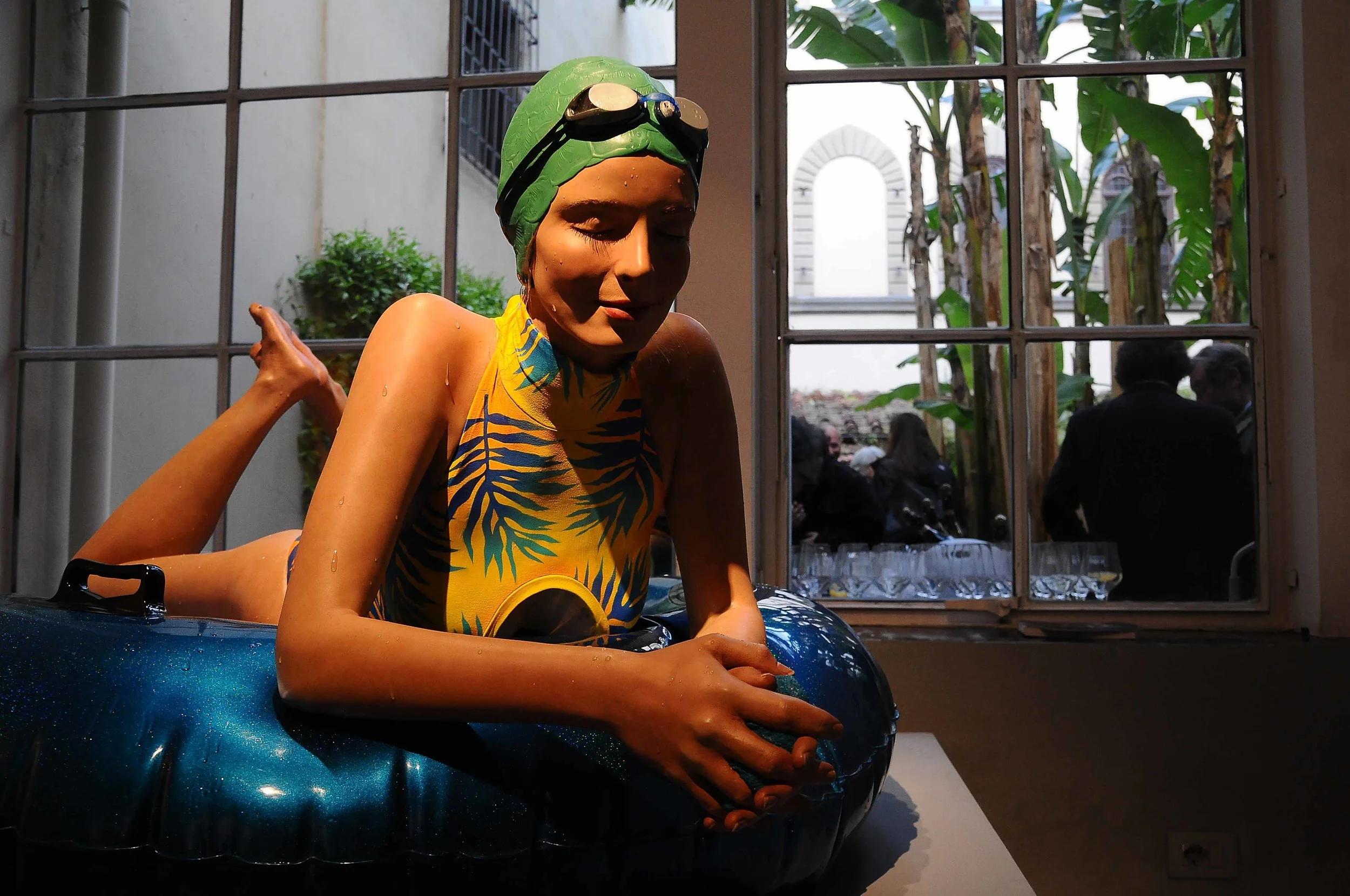
Diver, 2011. Painted Bronze. 77 x 25 x 11 inches.
Viewing Feuerman’s exhibit Shapes of Reality at Aria Gallery in Florence is the perfect way to spend a summer evening.
The sculptor’s life-size Diver is now on view in the garden at Aria. Diver seeks to capture the motion made by a diver as his body arches, goes backwards, and a ‘C’ shape is formed. This shape represents perseverance and balance as well as the struggle to achieve.

Diver, 2011.
Feuerman sought to accentuate the elegant ‘C’ shape to highlight the beautiful struggle of muscle and body that ensues when a diver pushes themselves past the limits of the ordinary.
As an Artist, Feuerman recognizes the symbol of the diver as a kindred artistic spirit. The Diver is perched on the edge, readying himself for more than just a dive; he is about to create and define his own reality. Feuerman pursues this same bold path with her sculptures.

Also on view at Aria Gallery is Next Summer, Monumental Brooke with Beach Ball, Capri as well as Serena Diamond Dust Shower.
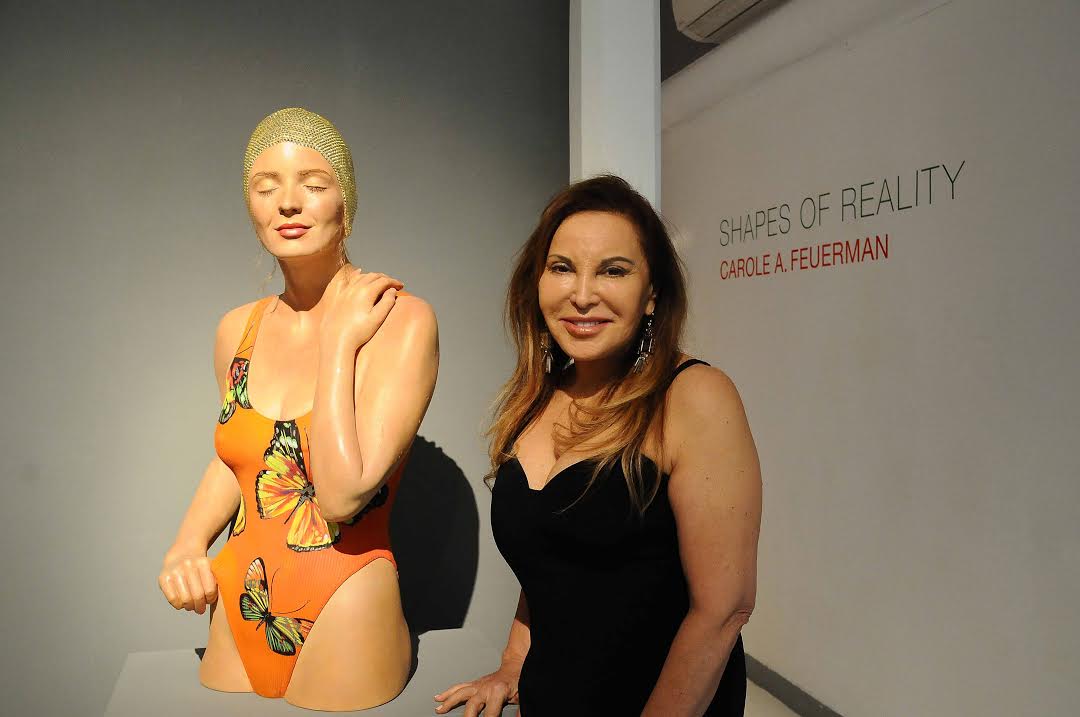
Friends new and old, hungry collectors, delighted first-timers, and eager Press toured the gallery of bewitching swimmers.

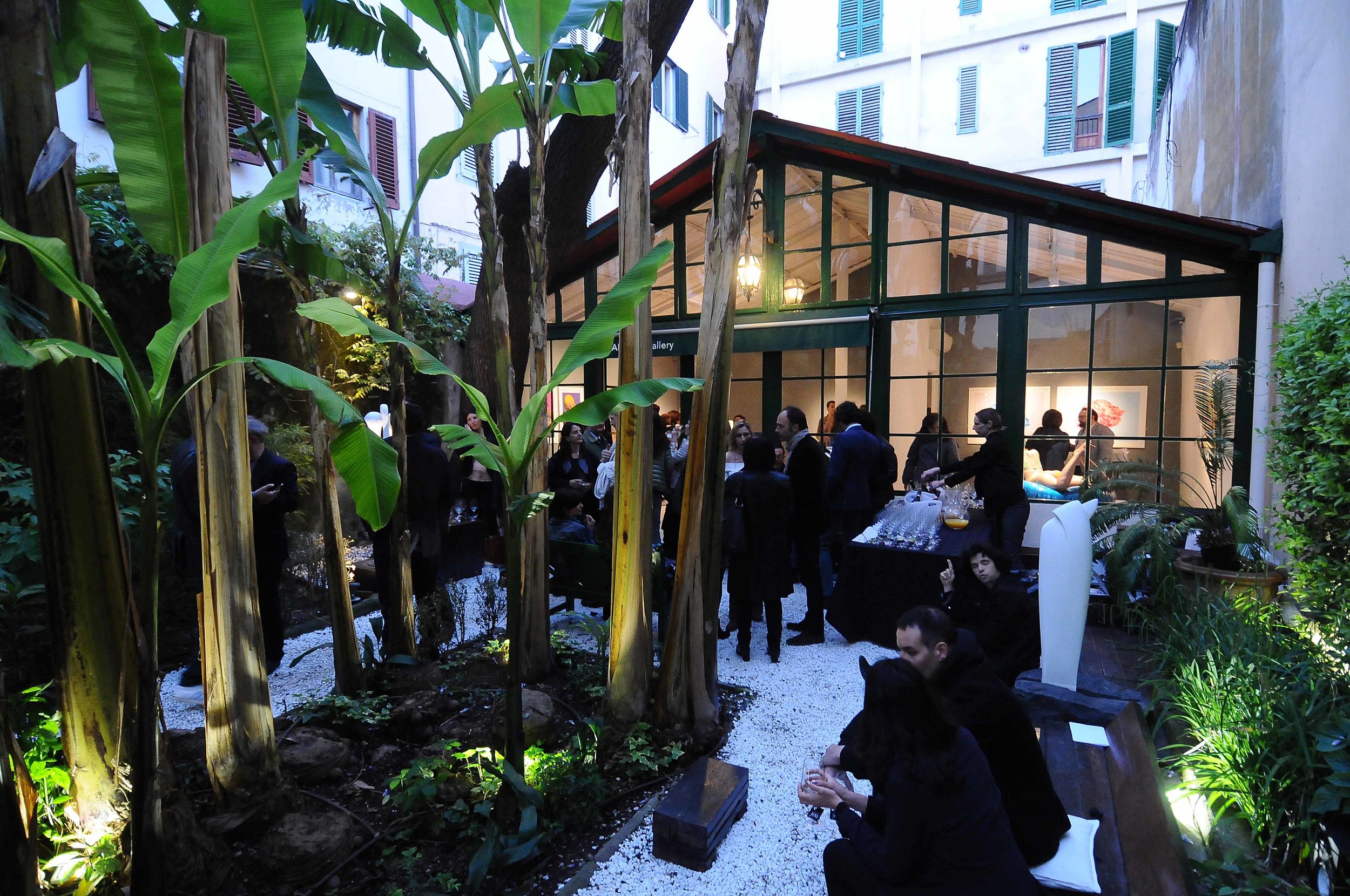


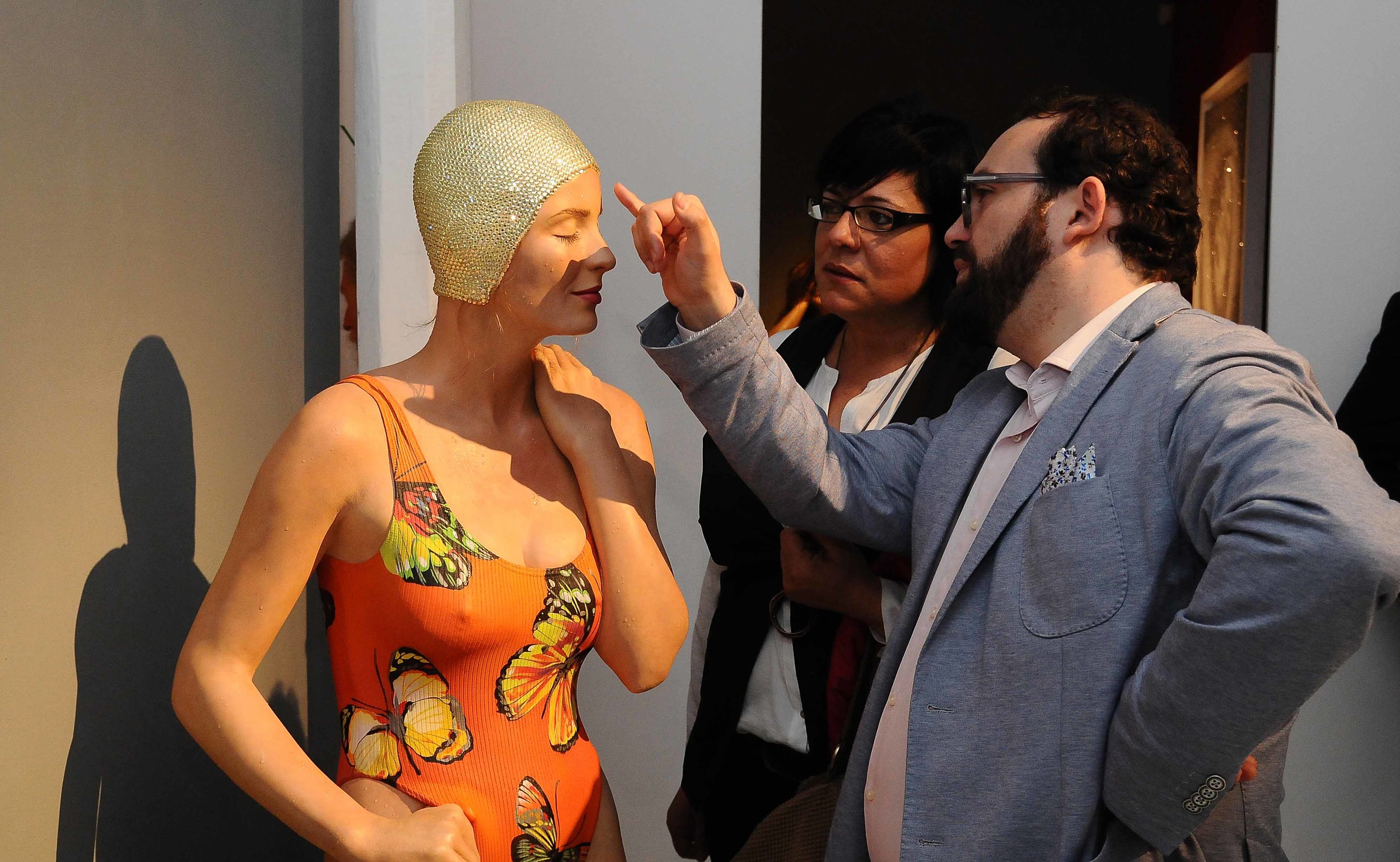
All were united by the undulating energy imbued in the sculptures. Feuerman’s passionate dedication to detail is world famous and when given the chance, admirers get as close as possible to revel in these sundry specifics.

Carole Feuerman and Ariela Wertheimer Show Together in New York

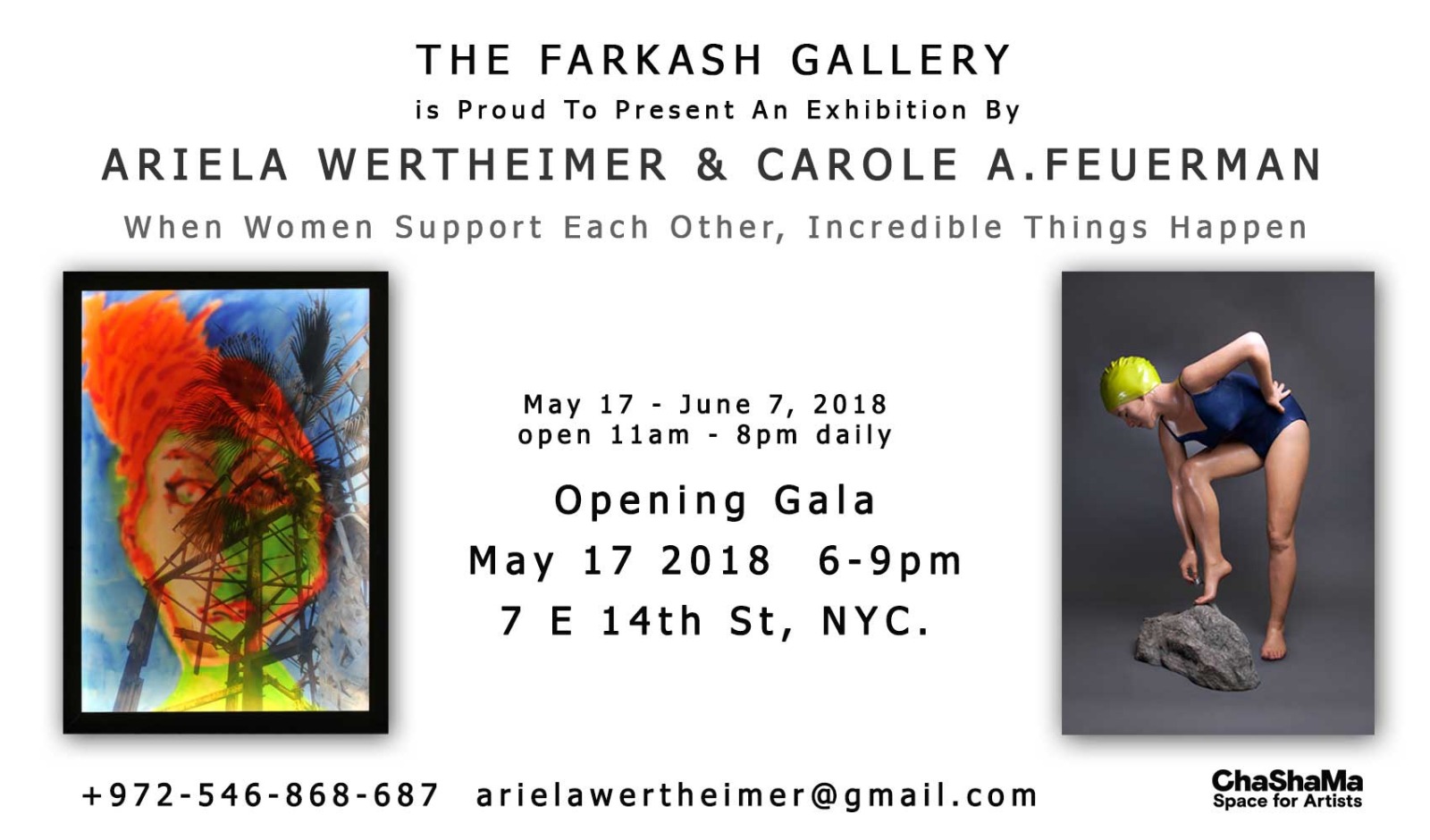
On May 17th Carole and Ariela Wertheimer opened a show at The Farkash Gallery on 14th Street. The show was called When Women Support Each Other, Magical Things Happen. Wertheimer is an Israeli artist who met Carole at Art Basel in Miami, although she wrote that she had been encountering Carole’s sculptures across Europe for some time before they met in person.
In the space, several of Carole’s Swimmers were surrounded by Wertheimer’s hanging light boxes from her Lightbox Portraits series. The light boxes each present two images: photographs that Wertheimer captured in Jaffa, a port neighborhood of Tel Aviv, along with transparent painted portraits and other illustrations that are overlapped with the photos.
From one perspective, Swimmers and Lightbox Portraits are linked in a liminality, a between-ness. Carole’s Swimmers, captured recently emerged from the water and still dripping wet, seem frozen between different moments, while the port architecture and bodies that Wertheimer shows seem caught between different worlds.
However, I think the most important connection between the works is in the intimacy of each specific piece. Maybe that intimacy is rooted in liminality: theorists of religion like Victor Turner have offered that the liminal space that exists inside of a ritual is a sacred place to encounter a substance of our self temporarily released from social structures. Maybe in the between-ness of Carole and Wertheimer’s portraits we find the unbridled self of their subjects: the private aggression of Wertheimer’s The Neighbor in the Neighborhood, the self-assured curiosity of Carole’s The Message.
Talking with Carole and reading Wertheimer’s writing on the show, they seemed pleased and enthusiastic about the feeling of being led to one another’s work, about the confluence of fate and hard work that produced the shows “magic”. The opening was definitely a magical night with a crowded room and many tasty drinks and snacks circling around!
If you’re in New York in the next month, you can stop by The Farkash Gallery from 11 to 8 daily to catch the show. Have a look before it comes down June 7th!
—Craig Hartl
Her Subject is Human: Tools, Legacy, and Power
I’ve been making sculptures for almost five decades. My pieces have been seen around the world since the 1970s. When people see my work, they’re taken aback: children ask their parents if the figures are real people, they don’t know how to react to them, they’ve never seen anything like them.
Like every artist, my work is part of a historical lineage. The art movement I’m associated with is called hyperrealism. The term was first used in 1973 as hyperréalisme by the Belgian art dealer Isy Brachot. The show he put together focused on the American photorealists working at the time, men who made paintings that focused in specific and intimate detail on their subjects to reveal a truth that transcends what a camera can capture.
The term became popular in the following years. Artists like me that were building and painting life-like fiberglass or bronze sculptures came into its fold. The term even reached back into time, and so the canon of Pop sculptures that artists like Claes Oldenburg and Duane Hanson were producing in the 60s and early 70s became part of the lineage too.
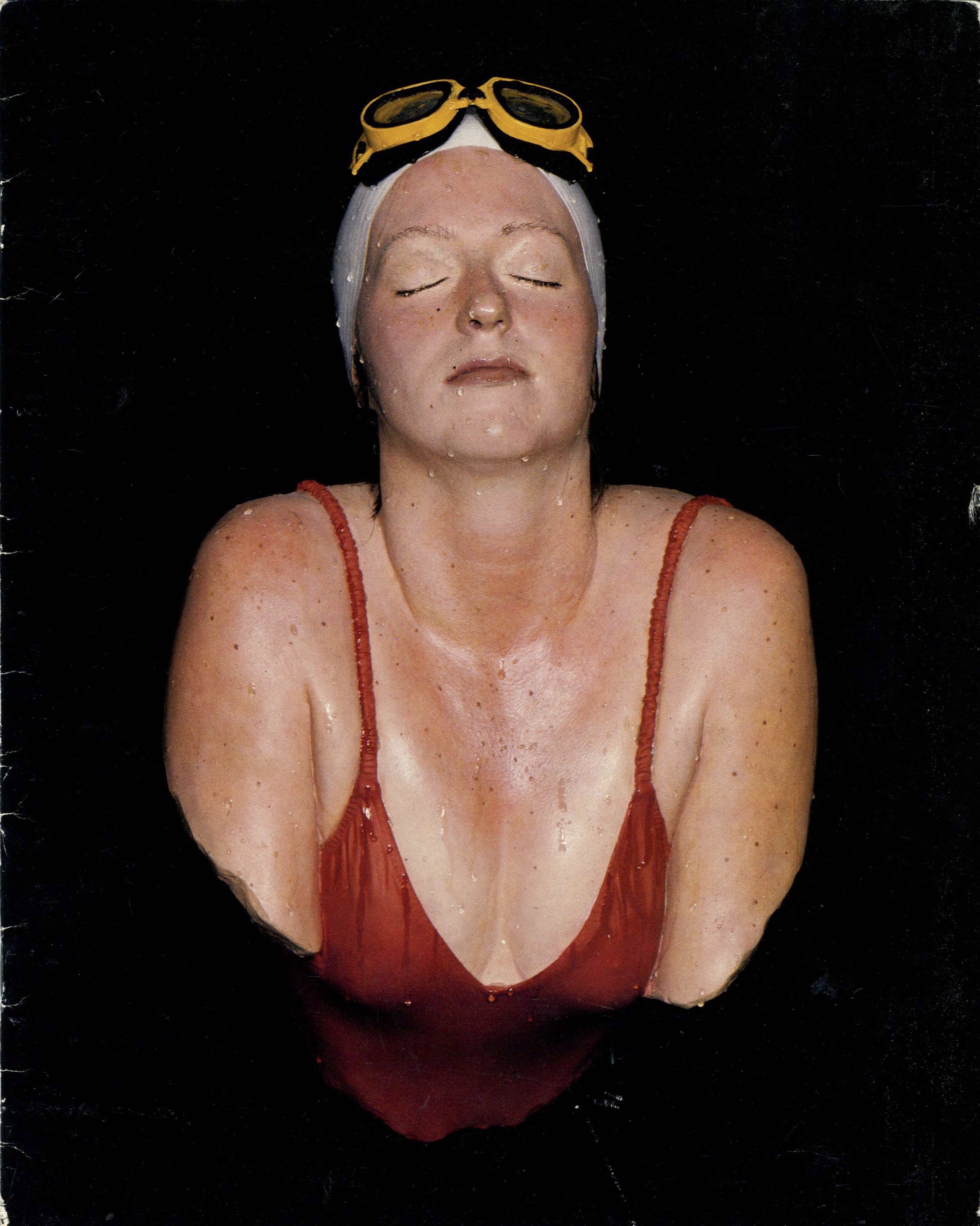
Catalina, 1981
For as long as there has been a thing called “hyperrealist sculpture” I’ve been someone who has shaped and defined the width and breadth of that movement. However, in the production of the history of hyperrealism and even more broadly of life-like sculpture, I have seen my work passed over and reduced while my contemporaries have been elevated.
Institutions like the Met and MoMA have been central players in separating which practitioners become the canon of a movement. Hyperrealism is featured prominently in a show on at Met Breuer right now called Like Life: Sculpture, Color, and the Body (1300-Now). I respect and value the 120 art objects that are included in the show, and in principal I don’t mind that my work doesn’t appear. However, when I went to visit this show recently, it got me thinking about what differentiates my work from those of my contemporaries from the 1970s and 1980s.
So here we go: I think we should talk frankly about the operation of patriarchy in the art world.
Here’s the thesis:
Men’s voices have dominated the industry of art criticism. See Clement Greenberg, see the Royal Academy of Art, etc.
Even when it comes to female subjects, the art that is valued is that which depicts the gaze of male artists. See the ratio of nude women subjects to women artists in the Met’s Modern Art Sections that the Guerrilla Girls made famous: 85% of the nudes are women, while only 5% of the artists are.
Art which elevates the way a woman looks at anything, and maybe especially women, is written out of history. See Romance novels, see Lifetime movies, see the silo-ing of feminist art.
This isn’t shocking to anybody, but I think that it’s worth repeating and considering, and I want to speak to what is lost by dismissing my perspective on female identity.
My sculptures of women are portraits of strength and power and balance. They aren’t an allegory for these things, which of course has been a long staple of the use of women’s bodies in men’s art. Instead, each figure is at a point in her personal journey that has allowed her to recognize these things in herself.
There is a wide functional gap between that depiction and those of my contemporaries John de Andrea and Duane Hanson. Hanson’s figures play with a tradition of satire: they are unhealthy, they have a problematic relation to consumption, they are parodies of the American domestic image that was airbrushed into every magazine of the 1960s. De Andrea’s sculptures have more to do with mine, in that the politics of his figures are less explicit; however he has acknowledged within his own oeuvre the particularity of his perspective, and the centrality of a heteronormative sexuality in his work.

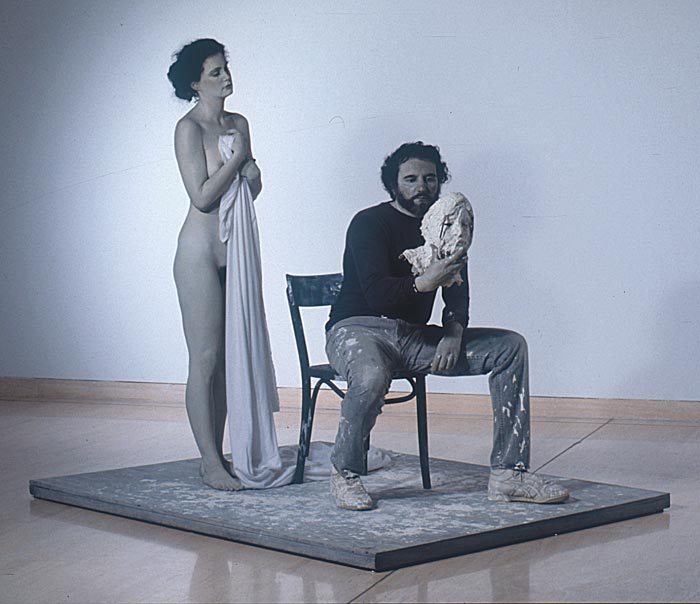
Left: One of Duane Hanson's Supermarket Shoppers. Right: John De Andrea's Allegory, After Coutbet.
This is particularly on display in sculptures like de Andrea’s 1988 piece Allegory, after Courbet. In this work, a female nude figure stands behind and gazes at a clothed male figure, who’s regarding an unfinished sculpture of a woman in his hands. These works are wonderful I think, in that they openly talk about the gendered subjectivity present in all production and consumption of artworks. However, that is a beginning of that conversation, not the end. De Andrea participates in that tradition: male artist, female subject, male gaze, male power.
My art subverts it.
The figures of women I create are not constructed for the male viewer to regard as a symbolic other, but for the human viewer to connect with as the vehicles of their individual lives. Each of them is in a moment that holds their inner strength, their power, and the wisdom that they’ve gained from the challenges they’ve overcome in their lives. I think that’s at the heart of their success in the art market. I also think that if hyperrealism is a tool, then my practice of representing women is an expansion of what that tool can be used for that’s worth noting.

Midpoint, 2017
My pieces don’t confront you with their personhood. They mostly don’t stare out at you and demand a response. That’s because they don’t need your gaze, their dialogue is internal, and that internal reality is something that has been left out of representations of women again and again. I don’t want people to look back at this era of art making and say that the internal reality of women was missing from the practice, but when work like mine and from art makers like me is left out of the canon that is exactly how it will look, and the women artists after me will have to start from scratch again.
That’s the function of the glass ceiling right? My career has been to make this tool for talking about the experience and reality of women, and I want the artists who come after me to have that tool. If I can’t break through into the canon, then they won’t have it, they’ll have to spend their careers inventing it for themselves and then never get to the point where humanity really moves forward, when we’re asking: alright, so what’s next?
—Carole Feuerman