
Understanding Superrealism
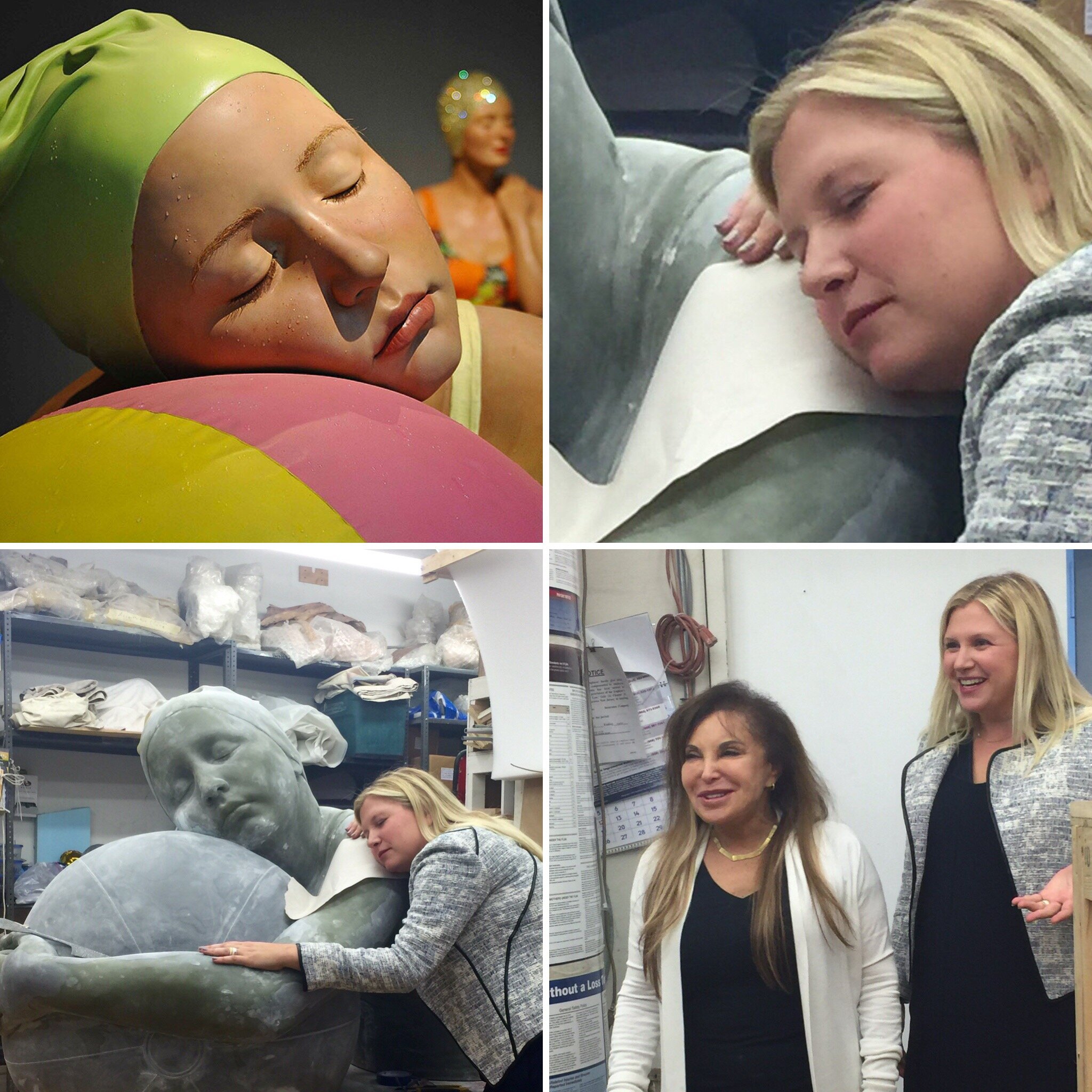
The Real Brooke Posing With Her Sculpture in Monumental Size
All the "Realism's" in Art Explained
Art is generally perceived as a way of detachment from the real-life. It is seen as a key to revealing some invisible meaning in the world that surrounds us. Besides, this is not entirely true for all genres of art. In superrealism, the thin line between reality and art is virtually erased. This happens in sculptures and paintings that these artists create. Many branches of realism focus on producing artwork that resembles a real-life image. Some of them even go further and beyond.
Labeled as a significant advancement of Photorealism, the newly established style still holds some elusive differences from its predecessor. Photorealists aimed to reproduce photographs with utmost precision. Their goal was that the human eye can not differentiate between the original and the painting. At the same time, the Hyper-realists took the technique even further. They have developed ways of including charm narrative and emotion into the image. As the saying goes “Hyper-realism create the atmosphere of surrealism as no one sees the world in such detail.”
Concisely known as Superrealism, the term Hyperrealism stood on the bases of the US photorealistic work of the late 1960s. Still, to create Superrealism, you must go over and above. You have to surpass the current level. This is precisely what Hyperrealism artists did. So, how did it go? Did they stray beyond the line of art, where their work became just an example of superb skill? Or did they blur the lines between art and reality? They have made way for a new hyper-artistic expression.
Difference Between Hyperrealism & Photorealism
The origin of the word Hyperrealism dates back to 1973. Isy Brachot was the one who fabricated the term. He used it as the title of a catalogue and exhibition at his gallery in Brussels. The exhibition involved influential artists like Richte, Gnoli, and Delcol. But, it was dominated by American Photorealists, including Chuck Close, Ralph Goings, Don Eddy, and Robert Bechtel. After the event, the term Hyperrealism was used by painters influenced by the Photorealists. Continuing the roots of Photorealism, the newly developed branch of realism managed to portray the images in an ultra-realistic manner. Besides, it was in contrast with the approach used in the traditional paintings of the late 20th century.
Also, Hyperrealism artists relied comprehensively on photographic pictures as a reference source. Still, they took it one step ahead. They aimed to create a more detailed and definitive rendering. Their artwork often includes a certain amount of narrative and emotion. While Photorealists inclined to imitate the photograph, Hyper-realistic artists struggled to achieve a different pictorial design altogether. They achieve it by integrating an element that is not there in reality. Besides, they intentionally entailed a softer focus on the portrayed topic. This created an impression of a new reality not seen in the original photograph. The portrayed illusions were captivating representations of reality. They were finely enhanced with a fresh layer of vision.
Conclusively, Hyperrealism offers a powerful way to explore our interactions as individuals with ourselves. It also examines how we interact with others in our everyday lives. For this specific reason, artists have the freedom to use Hyperrealism in portraying humans through an array of lenses. These range from the social and political to the psychological and antithetical. They also include the external workings of the human mind and body.
Superrealism is very different than Hyperrealism.
Historically, the word "Surrealism" is derived from the French surréalisme, which literally translates to "super-realism". In this context, it refers to the movement initiated by André Breton. This movement aimed to resolve the contradictory conditions of dream and reality. This resolution sought an "absolute reality" or a super-reality.
Objective: To express the "real functioning of thought." This is achieved by tapping into the unconscious mind and dreams. It remains free from the control of reason.
Distinction: While "Photorealists" superrealism focuses on external physical accuracy, "Surrealist" superrealism focuses on internal psychological truth.