
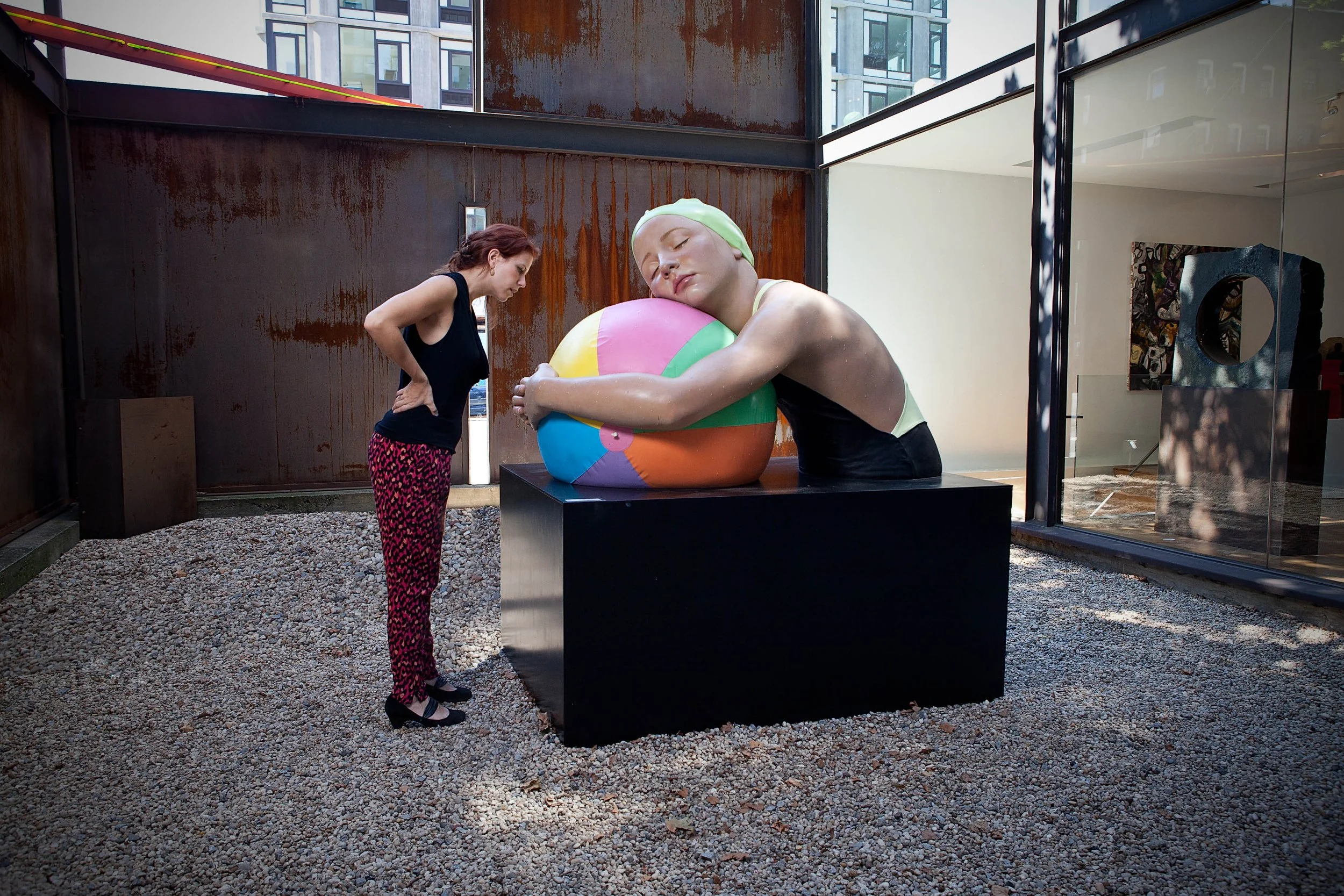
Brooke with Beach Ball | 2012 | 60 x 42.5 x 45 in | Laquer on Resin
Architecture sets the terms before art ever arrives. It dictates scale, pace, and perception. It decides where people slow down, where they hesitate, and where they pass through without looking. When sculpture enters that environment, especially as interactive outdoor art installations in Chelsea, New York, it must respond intelligently or risk being ignored. At Feuerman Studios, we treat architecture as an active collaborator, not a neutral backdrop.
Chelsea is structurally assertive. Converted warehouses, rigid grids, glass façades, and abrupt transitions between old and new create a visual tempo that never settles. The outdoor sculpture placed here has no luxury of passivity. It must hold ground. It must speak clearly. That demand has shaped how we think about outdoor work and how our art portfolio has evolved over time.
Architecture Directs the Viewer Before Art Does
People do not approach outdoor sculpture the way they approach gallery work. Architecture decides the angle of first contact. A building corner reveals a figure in fragments. A wide sidewalk offers a frontal encounter. A recessed entryway creates a pause without asking for one.
For interactive outdoor art installations in Chelsea, this matters. Interaction does not begin with touch or instruction. It begins with movement. Architecture choreographs that movement long before a viewer becomes conscious of it. Our role is to understand that choreography and place the work where it can enter the rhythm naturally.
At Feuerman Studios, we study how bodies move through built space. We consider sightlines, distances, and approach paths with the same seriousness we give to anatomy. When sculpture aligns with architectural flow, viewers don’t feel confronted. They feel invited.
Scale Is a Conversation, Not a Calculation
Chelsea’s buildings are confident. Some dominate through height. Others through mass. Sculpture placed among them must answer that confidence without mimicking it. Our monumental works are developed to remain human, even when they are large.
Scale is not about intimidation. It’s about proportion. A figure slightly larger than life can hold its own beside steel and concrete because the body is familiar. Viewers instinctively understand it. They measure themselves against it. That internal comparison is where engagement begins.
This balance is evident throughout our art portfolio. Each outdoor work reflects a decision about scale relative to architecture, not as an abstract exercise, but as a lived experience. The sculpture must feel grounded, as if it belongs exactly where it stands.
Superrealism Demands Architectural Awareness
Superrealism leaves no room for approximation. In outdoor environments, that demand intensifies. Buildings impose sharp lines, reflective surfaces, and shifting light. Any weakness in form or surface becomes immediately visible.
At Feuerman Studios, precision is not aesthetic preference, it is structural necessity. The clarity of anatomy, the restraint of gesture, and the exactness of surface treatment allow the sculpture to remain legible within complex architectural settings. As light changes throughout the day, details emerge and recede. The work stays composed.
Movement Activates Stillness
Architecture keeps people moving. Sculpture asks them to stop. That tension is productive. Our figures are still by design. They do not perform. They hold themselves.
When placed thoughtfully, stillness becomes a counterpoint to architectural momentum. Viewers slow down because something resists the pace. They circle. They look again. They adjust their own stance. This is interaction at its most honest, unforced, unannounced.
Within outdoor art installations in Chelsea, this quiet exchange feels rare. The city rarely offers stillness. When it appears, people recognize it immediately. Our art portfolio documents this repeatedly: the same sculpture elicits different responses depending on how architecture frames it.
Architecture Shapes Emotional Distance
A human figure set against an expansive façade can feel exposed. The same figure near an entryway can feel protective or introspective. These shifts are subtle but powerful. At Feuerman, we pay attention to how architecture alters the emotional distance between viewer and work.
This sensitivity is essential to outdoor art installations in Chelsea, where emotional noise is constant. The goal is not to overwhelm. It is to offer clarity. A composed figure within a demanding architectural setting creates balance rather than spectacle.
Our Art Portfolio as a Record of Dialogue
Our art portfolio is not a static archive. It is a record of conversations between sculpture and space. Outdoor works reveal how architecture influences perception, engagement, and meaning over time.
In Chelsea, those conversations happen publicly. Buildings frame the encounter. The city supplies motion. Viewers complete the work through their presence. Architecture does not disappear, it speaks, and the sculpture responds.
Final Thoughts
Architecture influences how art is approached, understood, and remembered. Within interactive outdoor art installations in Chelsea, structure becomes a guiding force, shaping movement and deepening response. At Feuerman, we work with that force, not against it.
Our art portfolio reflects a commitment to placing sculpture where it can exist with clarity and confidence. By respecting architecture, its scale, rhythm, and authority, we create outdoor works that feel deliberate, grounded, and alive within their environment. In Chelsea, interaction begins not with instruction, but with structure.
FAQs
1. How does architecture influence viewer interaction with outdoor sculpture?
Architecture guides movement and sightlines, shaping how viewers encounter sculpture before interpretation, making interaction intuitive rather than instructed in public.
2. Why is scale important in outdoor installations?
Scale relative to surrounding buildings determines whether a figure feels confrontational, balanced, or inviting within outdoor public environments for viewers.
3. How does stillness function within architectural settings?
Stillness counteracts architectural momentum, encouraging pause, reflection, and bodily awareness as people move through Chelsea’s urban spaces at street level.
4. What role does an art portfolio play in understanding site-specific work?
Our art portfolio documents how identical sculptures elicit different responses when architecture, light, and spatial context change over time publicly.
5. How does Feuerman approach interactive outdoor art installations in Chelsea?
At Feuerman Studios, our interactive outdoor art installations integrate sculpture with architecture, creating grounded engagement without spectacle or excess theatrics.